
Siena Cathedral is the kind of place where the details do the talking. The stripes aren’t just a style, the floor isn’t just decoration, and even small symbols on walls and chapels carry Siena’s story.
Below are a few Siena Cathedral facts visitors must know before they enter. We also share what to look for when you’re inside the Duomo complex.
1) The black-and-white stripes are Siena’s city colours
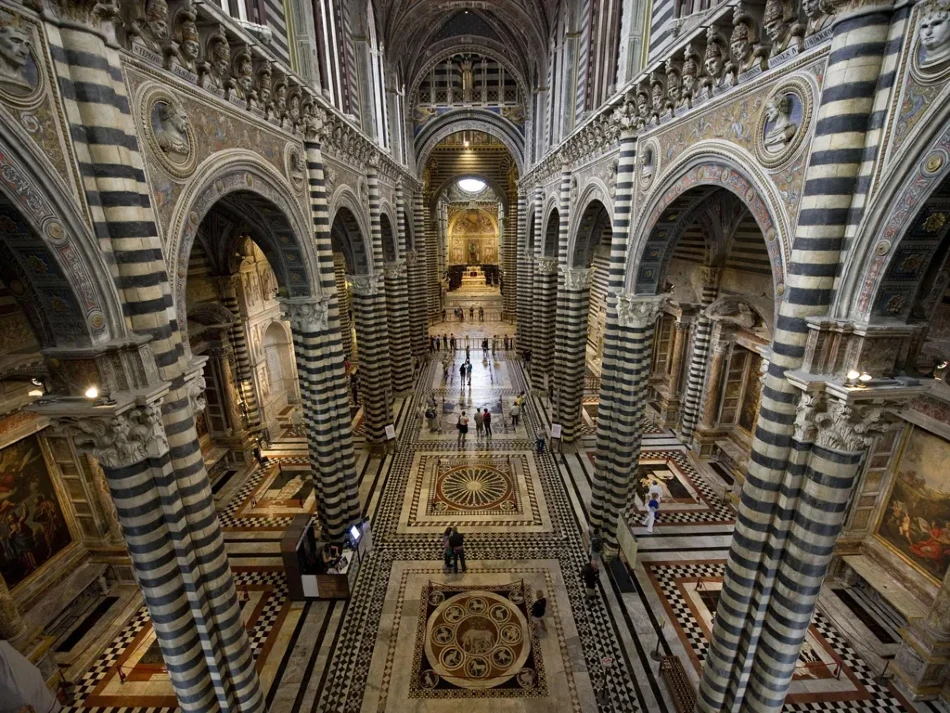
Siena Cathedral’s black-and-white marble stripes are one of the first things you notice, both interior and exterior.
The colours match Siena’s traditional black-and-white symbol (the Balzana), so the building feels tied to the city’s identity, not just its architecture.
Once you spot the pattern here, you’ll start seeing the same colour logic across the wider Duomo complex too.
The black and white also signify humility (black) and purity (white), virtues highly valued in medieval Siena.
2) Artists created the Cathedral’s floor over 600 years ago
Siena Cathedral’s marble floor wasn’t made in one go; it was built up over time, from the 14th to the 19th century, by around 40 artists, most of them Sienese.
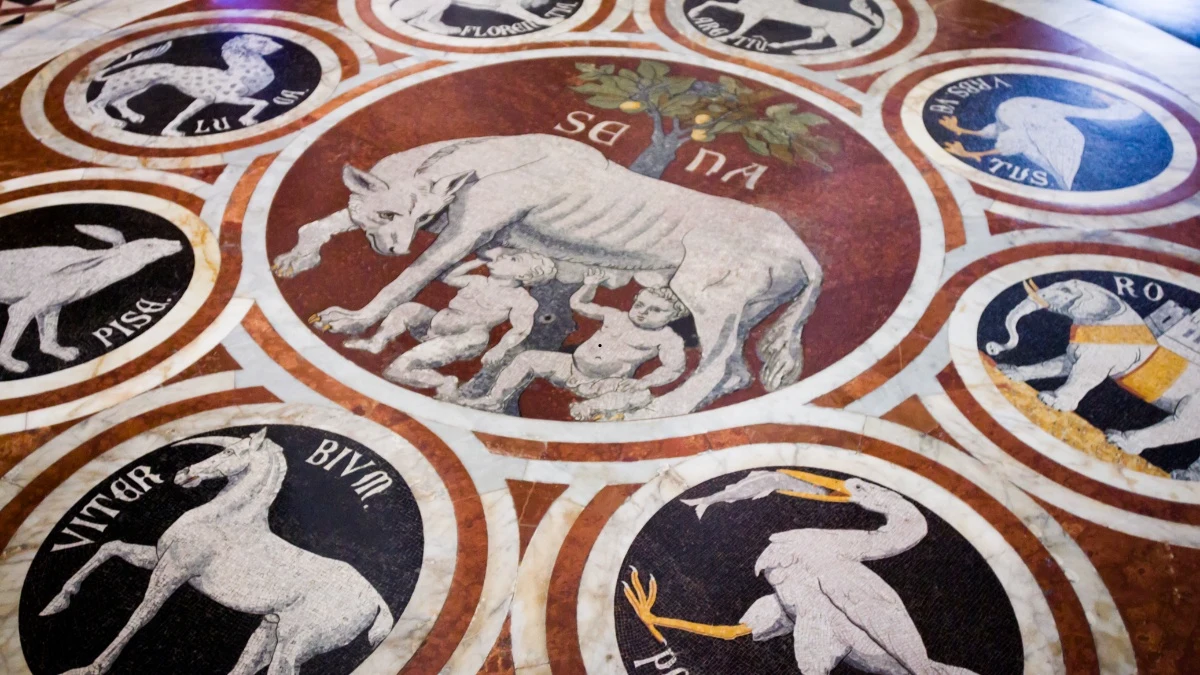
The floor is made up of 56 panels, created using graffito and marble inlay (mosaic) techniques. The scenes cover a wide range, sibyls, Old Testament episodes, allegories, and virtues, so it’s worth slowing down and treating it like a story, not just decoration under your feet.
Once inside, don’t miss the Wheel of Fortune, the She-Wolf of Siena with the Emblems of the Confederate Cities, and Emperor Sigismund Enthroned.
Planning note: the floor is covered for most of the year to protect it, and it’s only fully uncovered during limited viewing windows. Find out the dates
3) The She-Wolf appears in the Cathedral (and there’s a Siena legend behind it)
In Siena Cathedral, the She-Wolf of Siena appears in two places: on the cathedral floor’s mosaic and on the façade.
In Roman mythology, Romulus and Remus are twin brothers associated with the founding of Rome (the She-Wolf is their symbol). Siena’s local legend continues that story: it says Remus had two sons, Senio and Aschio, who fled Rome after Remus was killed.
One version adds a bold detail: before leaving Rome, they stole the Capitoline She-Wolf from the Temple of Apollo and carried the symbol with them into Tuscany. Senio is said to have founded Siena, while Aschio founded nearby Asciano, which is why a “Roman” symbol ends up appearing in Siena’s identity, including on the Cathedral.
4) “New Cathedral” was born from rivalry with Florence
In the 1300s, Siena launched a massive expansion of its cathedral, often called the “New Cathedral” project, partly driven by rivalry with Florence. The plan would have dramatically enlarged the Duomo, but the Black Death and its aftermath forced Siena to halt.
You can still see the remains of that unfinished ambition today in the Facciatone/unfinished façade area, which is why the viewpoint experience feels different from a standard cathedral visit.
Note: Need the easiest way to get there (train, escalators, parking)? Read how to reach
5) The Piccolomini Library isn’t “just a library”, it’s a painted time capsule
Inside the Cathedral, the Piccolomini Library is famous for its fresco cycle by Pinturicchio and his workshop (early 1500s).
It’s also where you’ll find a painted record tied to Siena’s church history, like scenes connected to Pope Pius III, who had strong ties to Siena (he was Archbishop of Siena before becoming pope).
Recommended Reading: If you are unsure, check whether Siena Cathedral is worth the visit.
6) The Crypt was rediscovered in 1999, after its paintings had been hidden for centuries
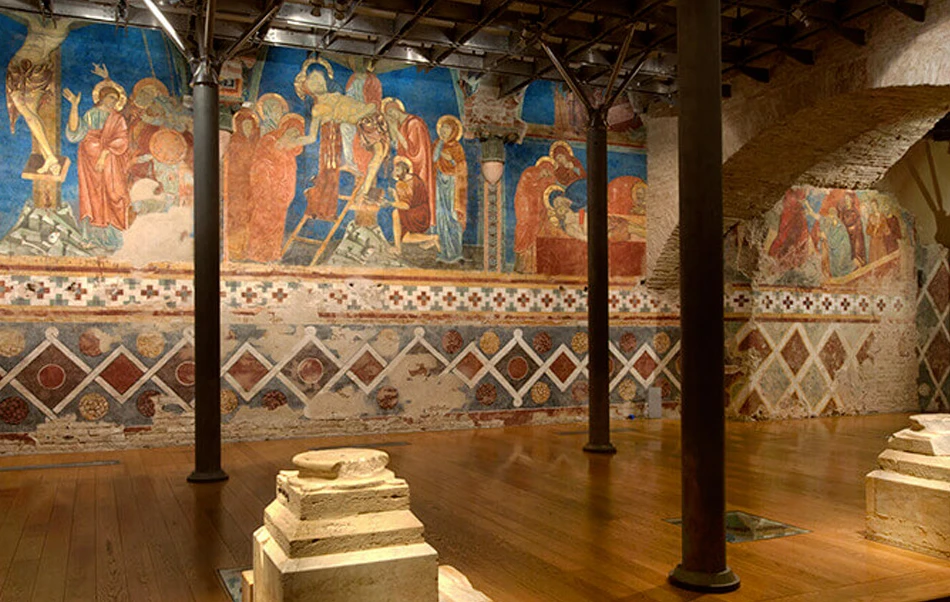
The Cathedral Crypt is one of the biggest “surprise” stops in the complex. It was rediscovered during work in 1999.
What visitors come for is the fresco cycle: sources describe about 45 scenes from the Old and New Testaments, spread across roughly 180 square metres of decorated surface.
And yes, the reason people keep repeating the “700 years” line is that the paintings were hidden for roughly that long before modern visitors saw them again.
7) Some “Cathedral works” are now in the Opera Duomo Museum
Not everything that mattered stayed in the church interior. The Museo dell’Opera is where you go to see major works up close, especially pieces that were moved for preservation or display.
A key example: Duccio’s stained-glass rose window is associated with the museum collection rather than the Cathedral wall, where a replacement is shown today.
Want to plan your visit? Start with what to see in Siena Cathedral
8) The Palio links back to the Cathedral after the race
Siena’s Palio isn’t only a Piazza del Campo moment. After the race, the winning contrada traditionally goes to the Duomo for a Te Deum / thanksgiving, and the victory banner is part of that ritual.
If you’re in Siena around Palio season, this is one of the most “local” ways the Cathedral stays connected to city life.
9) The Cathedral stands on an older sacred site
According to Opera Duomo Siena Museum, the current Cathedral replaced an earlier church dedicated to Mary (around the 9th century) and the site is linked to an even earlier temple tradition.
It’s the kind of fact that explains why the Duomo complex has so many layers, architectural, religious, and civic.
Note: Check out the OPA SI PASS, which provides access to the Duomo Complex sites.
10) St. Catherine of Siena shows up in the Duomo’s story, too
St. Catherine of Siena, a 14th-century mystic and Dominican tertiary, was closely connected to the Duomo and regularly visited it.
You’ll see her referenced in artworks connected to the Cathedral and the museum.
If you’re already visiting the Piccolomini Library, look for the fresco that depicts the canonization of St. Catherine (1461); it’s one of those details people miss because they’re focused on the room as a whole.
11) Piccolomini Altar: a planned tomb that became an art stop
The Piccolomini Altar was commissioned by Francesco Todeschini Piccolomini as a future tomb. He later became Pope Pius III, and after his death, he was buried in the Vatican instead.
What makes the altar a must-see is that it features four sculptures by a young Michelangelo(1501–1504), including St. Paul. Even if you’re not hunting for Michelangelo, this stop works well because it’s on a normal interior route, and you don’t need a special detour.
Bonus Fact: Saint Galgano’s “sword in the stone” is a nearby day trip
People sometimes connect Siena Cathedral with the “sword in the stone” legend (Saint Galgano Guidotti, a 12th-century knight), but the actual sword isn’t in the Duomo. It’s kept at the Montesiepi Chapel by the Abbey of San Galgano, around 35 km from Siena.
What you may see in Siena, as part of the story, is a reliquary linked to Saint Galgano (his head), which has been displayed during special exhibitions.
Ready to lock it in? See ticket options here
Frequently Asked Questions
Here are the questions visitors ask most often when reading Siena Cathedral facts and planning what to notice on-site.
Is Siena Cathedral famous mainly for the floor?
The floor is a main feature, but it’s only one piece. The Library, sculpture, chapels, and the museum/crypt stops make it a “full complex” visit.
How many panels are on the Siena Cathedral floor?
The floor program is commonly described as 56 panels, built over centuries.
Is the Crypt really “newly discovered”?
It isn’t new, but it was hidden and later brought back into view during work in 1999, which is why people describe it that way.
Why were the Crypt frescoes not seen for 700 years?
Because the painted space was sealed/covered for centuries before the 1999 rediscovery, modern visitors are the first in a long time to see the frescoes directly.
Does the Cathedral include the Facciatone viewpoint?
The viewpoint relates to the unfinished “New Cathedral” structure and is typically treated as part of the wider complex experience rather than a quick interior-only visit.
Is the Palio connected to the Cathedral, or only to Piazza del Campo?
It’s connected to both. The race happens in the Piazza, and the post-race thanksgiving at the Duomo is part of the traditional flow for the winning contrada.
Where do I see Duccio’s rose window, inside the Cathedral or in the museum?
Many guides describe the original as part of the museum collection, with a replacement shown in the Cathedral. If it matters to you, plan to include the Museo dell’Opera.